How 'Kiss of the Spider Woman' Reframes its Oppression Story for 2025
A new incarnation of the musical classic is here. So how does it hit through today’s lens?

good.film
a year ago

Share

It started life as an award-winning novel. Then, a groundbreaking drama in the 1980s that won the late William Hurt a Best Actor Oscar. In the 90s, it was transformed again - this time into a record-setting Broadway musical (with music & lyrics by the legendary Kander and Ebb) that bagged 7 Tony awards. Now, nearly half a century on, the web’s being woven all over again.
In 2025, Oscar-winning director Bill Condon (Chicago, Dreamgirls) breathes new life into Kiss of the Spider Woman through a modern day lens. And to be fair, you could argue its core themes - sexual identity, oppression, resistance and self expression - make the story even MORE relevant today than when it first unspooled in cinemas.
Backed by a sizey Hollywood budget and led by a global megastar in Jennifer Lopez, we were fearing something sanitised, to be honest; all gloss, no depth. Instead, the film’s moving portrayal of two male prisoners who fall in love - one a dreamer, one a fighter - is the bedrock that gives Kiss of the Spider Woman its meaning and its staying power.
Okay, set things up for me - what’s the context of Kiss of the Spider Woman?
It’s a strange title, right? Very gothic, very “throwback”. And a grim cement prison mightn’t be the first place you think of for a lavish movie musical. But it all makes more sense in the first 5 minutes of the film, when Director Bill Condon (who freshly adapted the original 1976 novel by Argentine writer Manuel Puig) gets us up to speed with the characters and the stakes.
It’s May 1983 in Argentina, and Valentin (Mexican actor Diego Luna, Andor) is a political prisoner. At least, “that’s what they tell me”, he says to his new cell mate Luis (played by queer Los Angelino Tonatiuh Elizarraraz). Luis is a gay window dresser who’s been convicted of “public indecency” which, he quite proudly announces, was conducted with a man. Gasp!
Straight away, we get where they stand. Valentin is prickly, practical and reads biographies of Lenin for fun. Luis is talkative, out and proud, and he’s fine with Valentin’s activism: “I respect all ideas,” he tells his cell mate, “as long as they respect mine.” They’re clearly opposed on many spectrums - but fundamentally, they’re both “resistors” of oppression. Kindred spirits, then…?
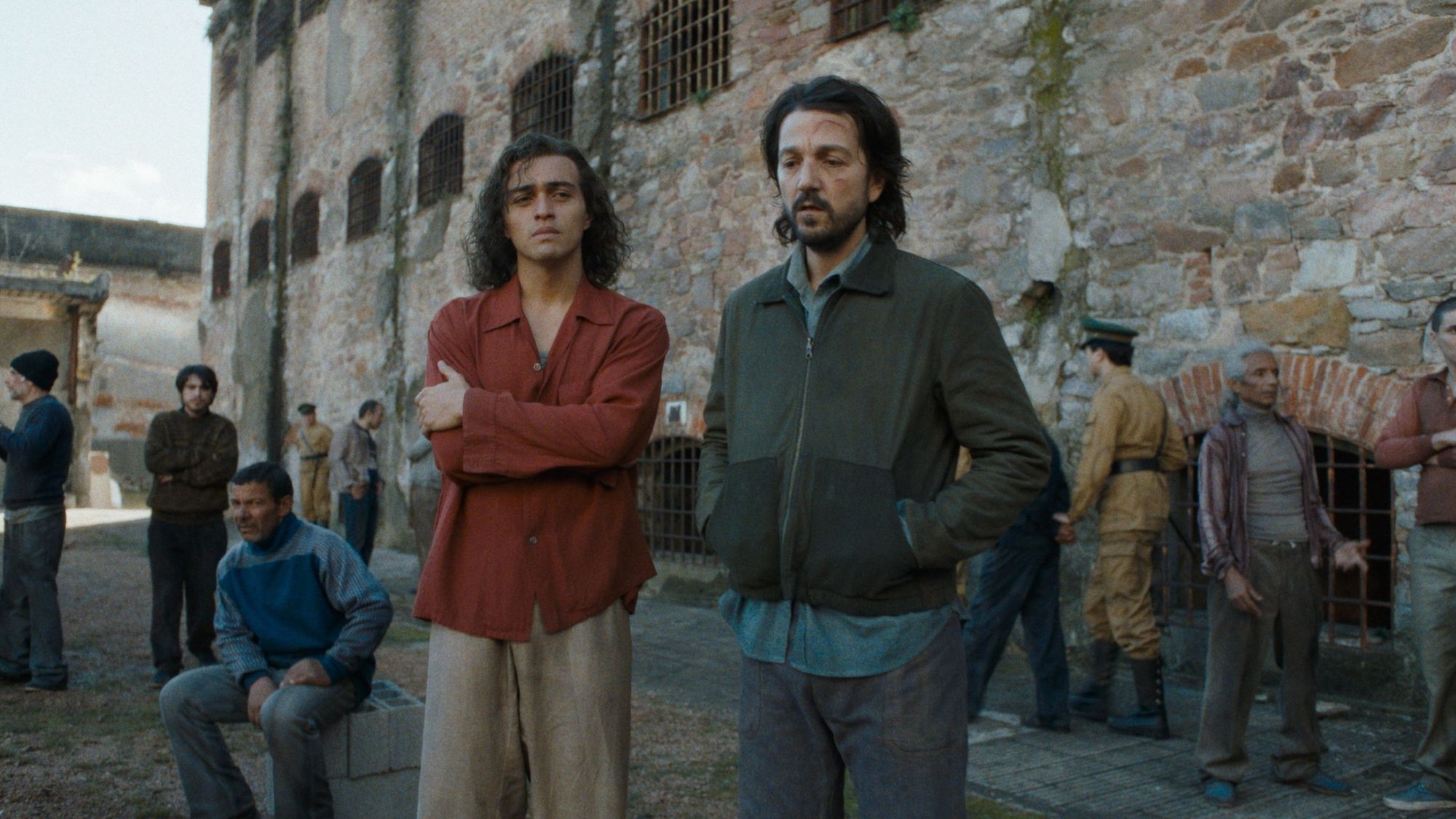
What’s going on in Argentina during Kiss of the Spider Woman?
In a nutshell, the movie’s set right at the tail end of what became known as the "Dirty War" - a stretch from 1976 to 1983 when Argentina’s military dictatorship secretly kidnapped, tortured, and killed thousands of people they deemed to be political opponents or left-wing activists. That obviously includes resistance figures like Valentin - AND homosexuals like Luis, who were openly called “degenerates” (and privately, far worse).
We won’t get into a whole treatise on South American political history (and to be honest, there’s better films for that). But there’s a real sense here that Bill Condon and his team set out to do serious justice to the political realities of the time and place their story is set, and not just give lip service to the Dirty War. In doing that, fair warning: things do get pretty grim.
As for that odd title? It’s the name of Luis’ favourite movie, an old Hollywood musical starring his favorite silver screen diva, Ingrid Luna as Aurora (played by J-Lo herself). And since they’ve got nothing else to do in their leaky cell, Luis decides to act out Kiss of the Spider Woman for Valentin, scene by scene. He knows it by heart, and it’s a heart that beats with Latin passion.

So wait… is Kiss of the Spider Woman a musical?!
Sure is. And when Luis first dives into his reenactment and the screen bursts into lavish colour, it's kind of a shock from the grey prison walls - of course, that's the point. We’re MEANT to be transported. It’s the idea that stories and fantasy are a kind of fuel for the oppressed. For Luis, singing and performing are an escape; a shield from the disgust and discrimination he encounters daily.
Valentin’s resistant at first. “I hate musicals!” he spits. “They're pure propaganda! Made by the ruling class to put people's minds to sleep!” (which is pretty funny to hear as an audience member of a musical). He actually makes a good point about musicals being regressive. Valentin points out that when a male is threatened by a powerful woman in Luis’ favourite movie, his first reaction is to possess her: “He wants to turn her into a doormat!”
But Luis totally pushes back on that, arguing that there was much more respect for women in the golden era. It’s a moment that lands with a thud, because - well, he’s WRONG. Films of that era largely included women as glossy accessories: someone to drape off a dashing (male) hero to make him look like a winner. Yet Luis is adamant that women’s magnetism gives them power. Why is that? Perhaps it’s because he yearns to have the same kind of feminine allure? More on that below…
This insight into Luis’ idea of female power is represented by Aurora, the character played by J-Lo. It’s important to remember that the flashback musical sequences we're seeing are Luis' MEMORIES of his favourite film. Not the movie itself, but the way it looks in his mind. So there's this dreamy, campy quality. It's part of what makes Kiss of the Spider Woman so fascinating. We’re seeing 1940s desire, from the perspective of a 1980s man who wants to be a woman, all filtered and refocused through the lens of today. Phew! That’s not an easy balance to pull off.

How does Kiss of the Spider Woman explore queer identity?
Here’s the area where Héctor Babenco’s 1985 film really broke out. Playing the Luis role, William Hurt became the first leading actor in Academy Awards history to win an Oscar for playing an explicitly gay character. In hindsight, it was a bold show of solidarity for a community that was largely marginalised, and reeling from fearmongering voices in the midst of an AIDS epidemic.
Cut to four decades later, though, and there’s obviously been huge strides in acceptance for the LGBTQI+ community. For that reason, Kiss remolds Luis’ sexual identity somewhat: though it’s impossible in his current life, Luis admits to Valentin that above everything else, he “wants to be a woman”. And it’s here where the modern update draws on a much more nuanced understanding of sexuality.
It’s obvious that performer Tonatiuh and director Bill Condon want to represent a wider gender spectrum. Yet they never utter the term ‘transgender’. Remember, it’s 1983 - the character TODAY might identify as genderqueer or trans, but Luis is trapped in a time when those terms and visibility simply didn’t exist. Hence, reactions like when Valentin admits he’s disgusted at “people like you”, saying bluntly “If a man called me a woman, I would kill him.”
The satisfaction of Kiss is watching those attitudes shift. Luis has a habit of self-deprecating jokes (actually a really common trait in minority groups, as a kind of coping strategy). He says things like “I’m a window dresser. When the Junta is overthrown, I don't think they expect to see a bunch of sissies leading the march!” But after one too many put-downs, Valentin has had enough. “I cringe every time you make fun of yourself,” he urges Luis. “People look at you and see a monster, so you play the part. But you're not a monster, you're a man.”
Ultimately, though, Kiss is less concerned with Luis’ specific identity and more with his dignity. In their normal lives, Luis and Valentin’s paths would likely never cross. Even if they did, Valentin would probably roll his eyes at Luis’ flamboyance and collection of silk scarves (if he even looked up from his notebook). But together in their cell, the traits and colours of their “identities” begin to melt away. They stop seeing each other as labels like “gay”, “straight”, “activist” or “window dresser”. Instead, they bond purely as the person they each are inside.

Why is Kiss of the Spider Woman being described as polarising?
As we’ve found over and over, LGBTQI+ themes trigger a certain kind of polarisation that puts a film squarely in the crosshairs (just look at the IMDb User Ratings for the film below to see what we mean). We've written about this before - it’s called brigading.
Brigading is essentially coordinated backlash from online groups on platforms like IMDb and Letterboxd, who are opposed to the film’s open LGBTQI+ and Latino themes. Apparently, some Reddit threads have even coordinated downvoting as a protest against Jennifer Lopez herself (!) based on what they perceive to be her ‘overexposure’ - but isn’t that just an obvious smokescreen for racism?
The thing is, brigading against Kiss of the Spider Woman is particularly ironic - not just because the film’s received strongly positive critic reviews (nearly 80% on Rotten Tomatoes as we write this). But the core point - the one that beats at the heart of the film itself! - is that art, and great stories, CAN AND DO foster our empathy for others, and therefore connection.

How about Kiss of the Spider Woman’s casting and performances?
Here’s where Kiss really sings (forgive the pun). The natural warmth of Diego Luna as Valentin hits our empathy button hard. Luna isn’t the film’s only secret weapon though: that award probably has to go to relative newcomer Tonatiuh, who was born to immigrant parents from Mexico, and was raised by his mother and grandmother in East LA.
It’s obviously meaningful to have this South American story portrayed authentically by Latino and Latina performers. “With [this character], I returned to the totality of my being”, Tonatiuh told Variety. “Latinos and queer people everywhere are being asked to make themselves small. And [yet], we come from a long line of resilient and beautiful people in history. I think it's time to remember our dignity and to remind people of our worth.”
And on the topic of beautiful resilient people, yes, we’re happy to report that Jennifer Lopez is super engaging as the titular Spider Woman. It’s a surprisingly physical role - singing, dancing, dangling off spiderwebs (really). And while the multi-hyphenate superstar is arguably RIIIIGHT on the knife’s edge of being too old for the character (J-Lo’s 56 IRL), she really does nail it.

What’s the takeaway from Kiss of the Spider Woman?
There’s really three ways to look at this new incarnation of Manuel Puig’s 1976 story. One is at surface level: the jail scenes are poignant, and the lavish femme fatale film sequences are sumptuous and brimming with va-va-voom. It’s seriously a costume designer’s dream - anyone who loves old-school musicals or the lure of a Technicolor dance number will be in carnivalé heaven.
The second approach is to view Kiss as a kind of history lesson. One that urges us to keep our minds more open to difference. More poised to push back against “leaders” that aim to hang onto power by only pretending to solve problems (think: lack of housing, poverty, drug addiction, etc). Instead, they’re focused on marginalising and dividing communities.
But the third viewpoint is our favourite, and it’s one that backs up everything we know about the power of film and storytelling. Aside from their nationality, these two men are different in almost every way: Valentin is academic and grounded; Luis is a romantic dreamer. They have completely different views on equality. But by being incarcerated together - by sharing each other's lives, struggles, and dreams - they begin to accept (and eventually love) each other.
And it all happens through conversation: through stories they act out, and memories they recount. In its own way, Kiss of the Spider Woman is a microcosm of exactly what we need more of: more openness, more conversation, and more sharing, to enable humankind to see more eye to eye. Luis and Valentin’s bond is like a test case; a reminder that it’s impossible to know what you’ll learn from someone else’s perspective UNTIL you’ve heard it for yourself.
As Luis says in a letter to his beloved mother towards the film’s finale, “When I went to prison, I thought my life was over. But… I learned about dignity in the most undignified place.”